Vikings: Reading the Remains
The physical legacy of the Scandinavian Viking Age (c. 793–1066 CE) offers clues far stranger than the simple raider tropes of modern entertainment. When archaeologists unseal burial barrows and interpret runic inscriptions, they find an intricate world of climate grief, cryptographic wordplay, and cross-continental trade.
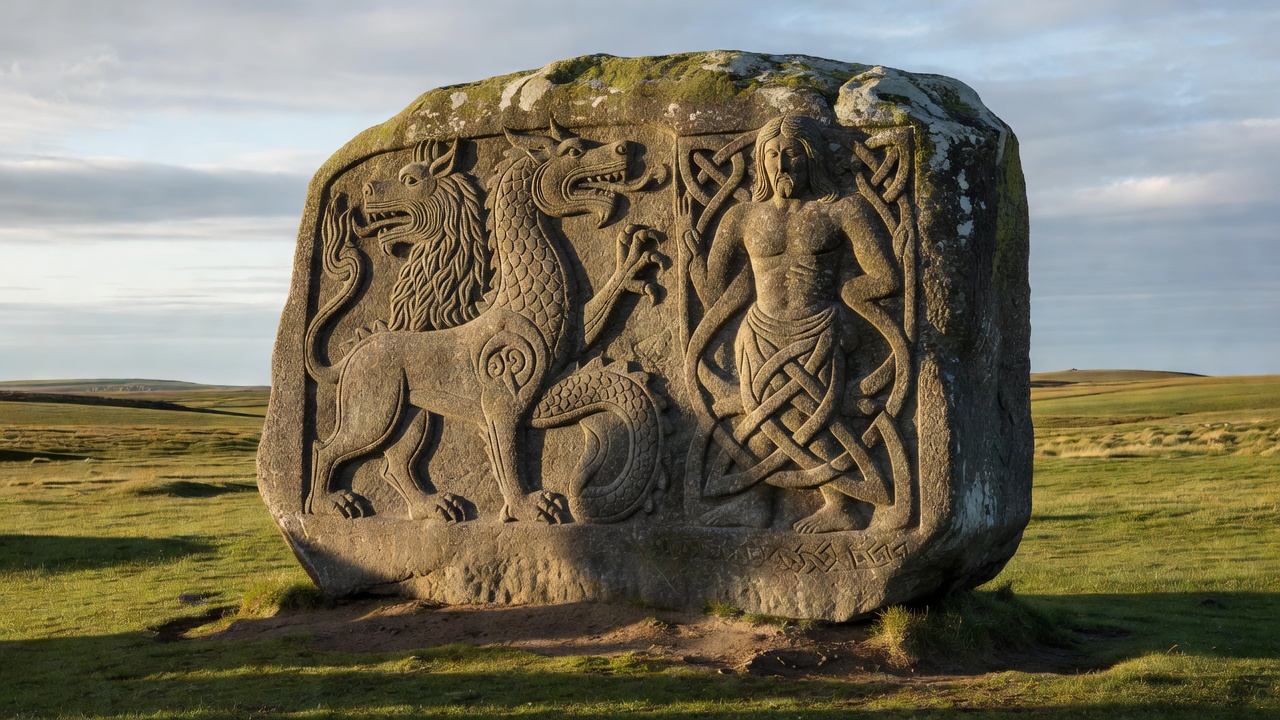
The Cipher of the Rök Runestone
In Östergötland, Sweden, the granite slab known as the Rök stone (Ög 136) contains the longest contiguous runic inscription known. Carved by a chieftain named Varinn in memory of his dead son Vämod, the stone does not simply convey sorrow. It uses cipher systems—including short-twig runes, elder futhark substitutions, and numerical shift keys—to encode a series of riddles.
For over a century, linguists assumed the inscription recounted lost heroic myths regarding Theodoric the Great. However, recent interdisciplinary analysis by researchers at Uppsala, Gothenburg, and Stockholm universities suggests an unexpected context: the extreme volcanic dust veil of 536 CE, which caused years of summer freezes and harvest collapses across Scandinavia. Varinn's text reflects deep anxiety about a recurring climate catastrophe, invoking the cosmic winter (Fimbulwinter) as he mourns the premature death of his heir.
The Oseberg Ship Burial: Royal Crypt or Sacred Sacrifice?
Excavated in 1904 near Tønsberg, Norway, the Oseberg burial remains one of the most astonishing archaeological discoveries ever made in Northern Europe. A 21-metre clinker-built oak longship was hauled inland, parked in a trench, and covered in blue clay and peat turf, sealing its contents in near-anaerobic conditions.
The Wooden Animal-Head Posts
Five intricately carved animal-head posts crafted by distinct masters known as the 'Academician' and the 'Baroque Master', whose functions remain wholly unknown to modern liturgists.
Silk Ribbons and Cannabis Sativa
Traces of red silk imported from the Byzantine Empire or Central Asia, along with a pouch of hemp seeds, demonstrating vast mercantile reach and ritual apothecary use.
Two High-Status Women
One woman aged 70–80 who suffered from advanced cancer and Morgagni-Stewart-Morel syndrome; the other, around 50, who died violently with a broken collarbone, possibly an attendant sacrifice.
The Warrior Chamber at Birka (Bj 581)
In the Swedish trading hub of Birka on Lake Mälaren, grave Bj 581 had stood as the textbook model of an ultimate Viking male commander since its excavation by Hjalmar Stolpe in 1878: buried with a sword, battle axe, fighting knife, armour-piercing arrows, two sacrificed horses, and a complete board game set indicating strategic battlefield command.
In 2017, genomic DNA testing led by Charlotte Hedenstierna-Jonson demonstrated conclusively that the remains belonged to a biological female carrying XX chromosomes. The findings ignited an intense international academic dialogue regarding gender roles, high-ranking military leadership, and how modern researchers project contemporary binary expectations backward into medieval Scandinavia.
Summary of Verified Archaeological Finds
Far from a primitive society driven solely by coastal pillaging, the physical archaeological record highlights a literate, calculating culture dealing with volatile northern ecosystems, intricate ship technology, and complex ritual governance.
Next: Explore Nordic Legends →